Publiziert in: Marktpuls
Frei

Briefings from Goldman Sachs - When will China's property sector recover? Samstag, 02. Dezember 2023 - 13:15

5116807290.png
The key takeaways today:

  • Why a recovery in China's property market could take years
  • The case for a strong US dollar in 2024
  • The 60/40 portfolio is back — and Charlie Munger's legacy
  • Are companies at an AI inflection point?
  • Briefings brainteaser: How much US holiday spending happens in brick-and-mortar stores?
Was this newsletter forwarded to you? (Sign up now.)
What China's struggling property sector means for the global economy and markets
28017002420.jpg

The road to recovery for China's property sector is expected to span multiple years, as China still faces the lingering aftermath of one of the largest recorded debt booms, explains Goldman Sachs Research's Kenneth Ho, Asia credit strategist, on Goldman Sachs Exchanges. But even as the country works to rein in an estimated $8.4 trillion in mortgage and property developer outstanding debt, Ho doesn't expect the leverage to result in a financial crisis as past housing crises have done in other countries. "Policymakers in China [are] very focused on making sure systemic risks don't emerge," Ho says.  

But there are risks that make this crisis different from prior downturns. One is the growing role of the secondary market: the buying and selling of existing homes. While the Chinese government can control many aspects of the primary market, from setting land prices to controlling developers' sales, it has far less control over what happens in the secondary market, explains Goldman Sachs Research's Yi Wang, who leads the China real estate team. "Because this is all consumer behavior, it's very difficult for them to control," she says. The secondary market is where Wang sees further deterioration, as the supply of homes rises and prices fall.

The impact of the downturn is far-reaching. "When you have this large segment of the economy contracting — and it's going to take years to get back to normal —  your potential growth takes a big hit," says Goldman Sachs Research's Hui Shan, chief China economist, who estimates China's potential growth at around 4%. The property downturn will also hit commodity markets. "Before the downturn, Chinese copper demand, just in the property sector, was even more than the entire copper demand from the US," Hui notes.

Why the US dollar could stay strong through 2024
Even in the face of continued global growth, the US dollar maintained its value in 2023 — and the story could be similar in 2024, according to Isabella Rosenberg of Goldman Sachs Research.

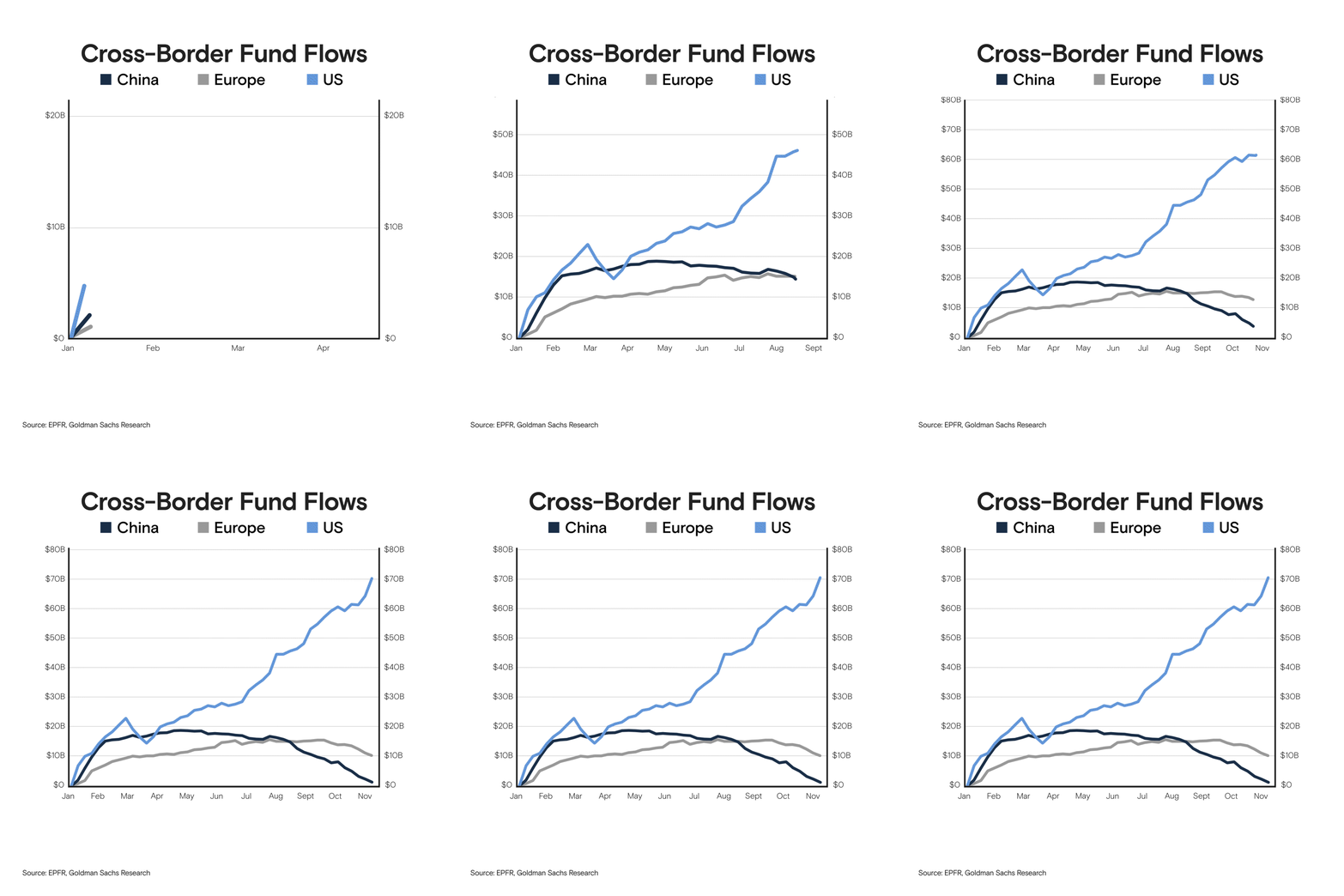
This is somewhat unusual. Typically when there's strong economic growth, the dollar is expected to underperform the currencies of countries viewed as more risky. But the US economy has outperformed in 2023, on track to grow at a 2.4% pace (as of November 15) that well surpasses the 0.4% consensus growth estimates at the start of the year. Given this backdrop and the economic challenges in Europe and China, "it's no surprise the majority of cross-border fund flows have been directed into the US," Rosenberg says.
17217012075.gif
Looking ahead to 2024, Goldman Sachs Research expects US growth of 2.1% (as of November 15), a forecast that's double consensus expectations. This environment could foster continued interest in US assets among foreign investors.

"While it might be compelling to forecast dollar depreciation from the top down," Rosenberg says, "US outperformance in 2024 means the dollar should remain in high demand."
The return of balanced portfolios
For much of this year, cash has been king. But investors may soon be ready to deploy that cash into riskier assets, Ashish Shah, chief investment officer of public investing in Goldman Sachs Asset Management, says on the latest episode of The Markets podcast.
 
Balanced portfolios — and bonds — are back. "We think in 2024, 60/40 is going to be back," says Shah, referring to portfolios with a 60% allocation to equities and 40% to fixed income. "A lot of clients are still sitting in cash, and that's been a fantastic trade," he says. But as expectations grow that the Federal Reserve might be done raising rates, the attractiveness of bonds has risen, driving prices higher. "I think the risk/return looks a lot better in bonds at these levels than it does for stocks," he says.
25417014276.png
More opportunities for stock selection. While the overall volatility of stock indexes has fallen, the volatility for single stocks has remained high — an indication that there are more diversification opportunities in single-stock names, Shah points out. "As more and more of the market buys into the soft landing...we're seeing winners and losers inside the stock market," he says. "So rather than just selling everything as you slow but have positive growth, investors actually buy and sell different stocks."
 
Reflecting on Berkshire Hathaway's Charlie Munger, who died earlier this week, Shah says: "He's going to continue to influence generation after generation of investors because his investment philosophy was very intuitive and something that was accessible to a wide range of individuals."
Is the ardor for AI starting to cool?
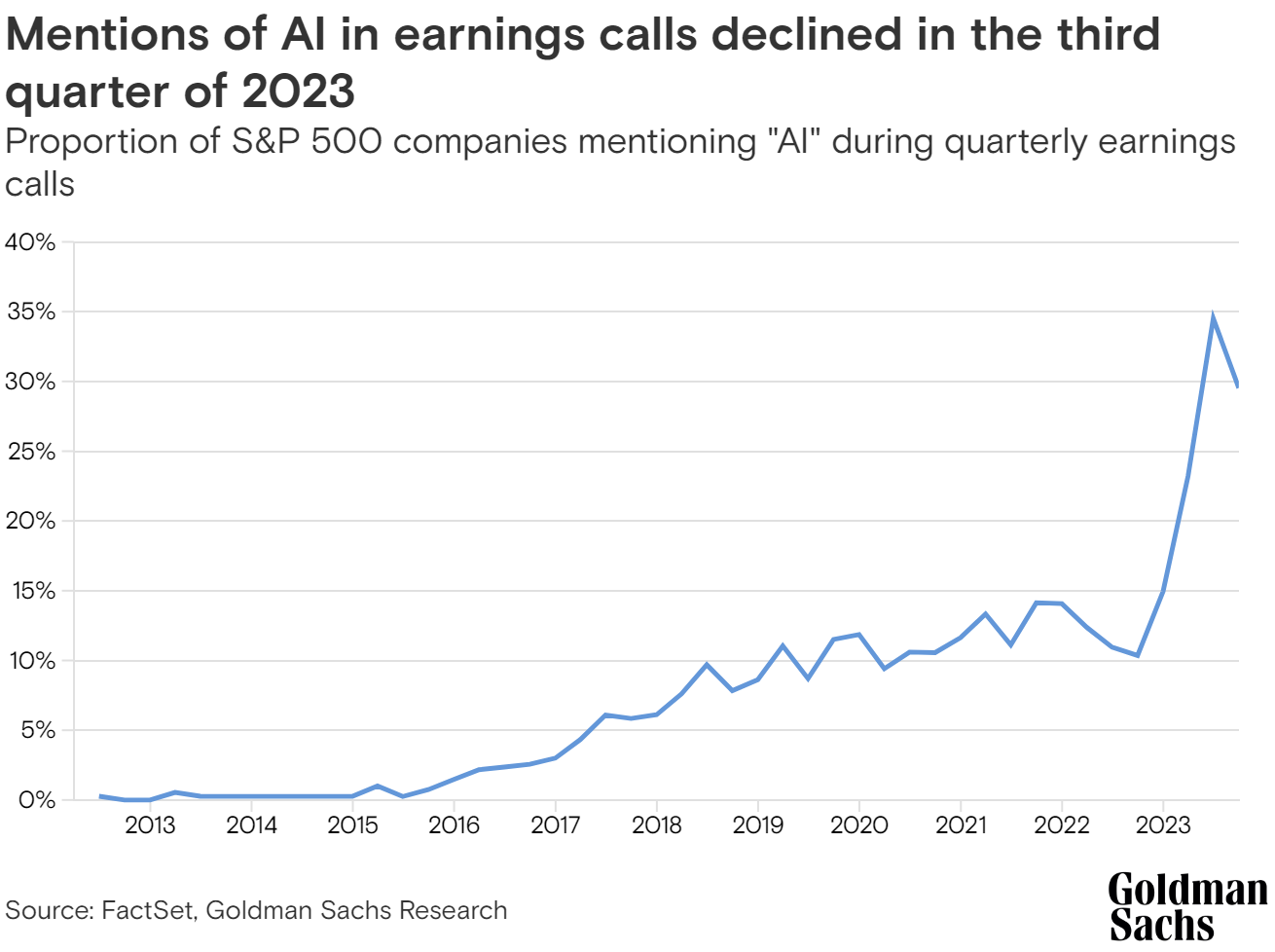
In third-quarter earnings calls tracked by Goldman Sachs Research, 29% of companies discussed artificial intelligence — down from the peak of 35% in the second quarter of 2023. It signals a potential inflection in management enthusiasm over the technology, write analysts David Kostin and Ben Snider in the team's report. The companies that did bring up their use of AI often discussed the heavy investment and expenditure involved, and said they expect capex and R&D costs to increase in tandem.
19017013533.png
Briefings Brainteaser: The Black Friday extravaganza
US holiday spending in November and December is expected to grow as much as 4% compared with last year, while online and other non-store sales are expected to increase as much as 9%, according to the National Retail Federation. Roughly what percentage of US holiday spending in 2022, which totaled $929.5 billion, happened in brick-and-mortar stores?

A) 15%
B) 30%
C) 50%
D) 70%

Check the answer here.
Goldman Sachs in the news
89816589278.jpg
42816521618.png